Organizations invest significant resources in hiring talented people, only to watch those people spend hours every day on manual coordination, chasing approvals over email, updating spreadsheets, and following up on tasks that should have resolved themselves days ago.
This is not a people’s problem. It is a process problem. When critical workflows depend on individuals to manually push each step forward, delays and inconsistencies are inevitable. A business process automation platform changes that dynamic by removing manual handoffs from recurring operational workflows. Instead of relying on people to remember, follow up, and coordinate, the platform executes process logic automatically: routing approvals, firing notifications, escalating delayed tasks, and maintaining a complete record of every action.
The result is faster cycle times, lower administrative overhead, and operations that work consistently regardless of who is in the office.
The Hidden Cost of Manual Workflows
Automation in business operations has shifted from competitive advantage to practical necessity. The manual alternatives, email chains, spreadsheet trackers, informal follow-ups, were designed for simpler environments. As organizations add headcount, departments, and process complexity, these approaches create compounding drag:
- Approvals stall when the right person is unavailable or unaware of a request is waiting
- Tasks get missed when completion depends on someone remembering to pass them along
- Managers have no structured visibility into how workflows are actually progressing
- Errors accumulate when process steps depend on individual interpretation rather than defined logic
- Compliance gaps appear because manual processes generate inconsistent documentation
A business process automation platform addresses each of these failure points by encoding process logic into the system itself. The workflow knows exactly where to route, who must act, and what to do when they do not respond in time, no human orchestration required.
How a Business Process Automation Platform Improves Efficiency
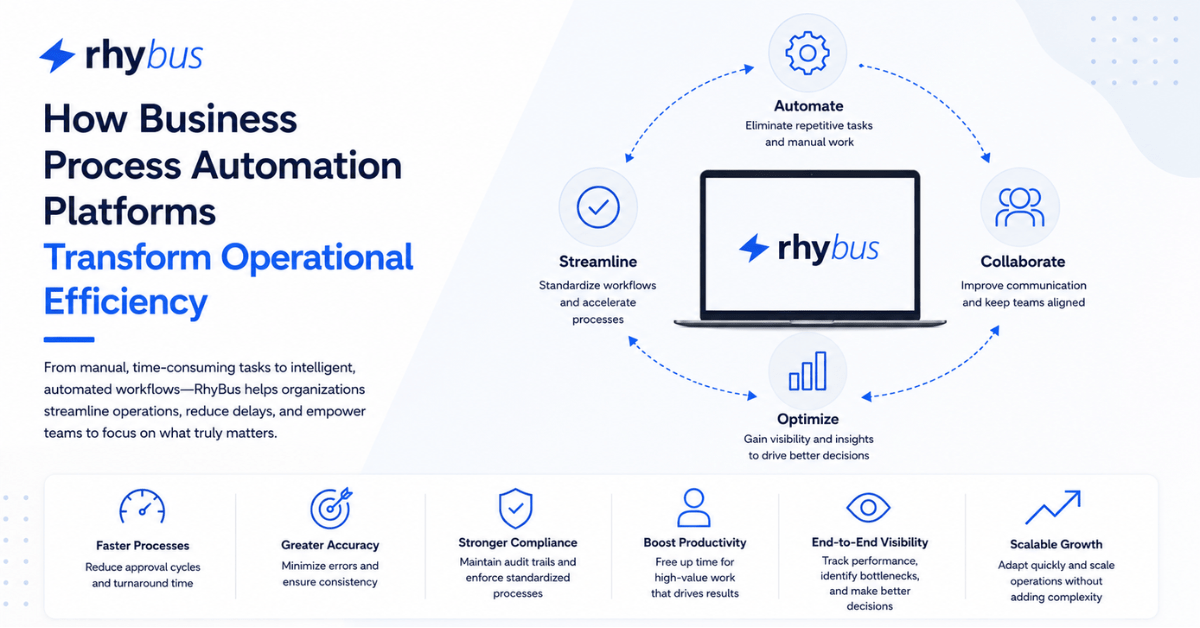
The efficiency gains from a business process automation platform concentrate in three measurable areas: speed, consistency, and visibility.
Speed improves because the platform routes work automatically. An approval request submitted at 9 AM reaches the appropriate stakeholder at 9 AM, complete with a clear notification and deadline. It does not sit in a drafts folder or get lost in a crowded inbox.
Consistency improves because process logic is defined once and applied identically every time. The same purchase request follows the same approval path regardless of who submitted it, what day it is, or how busy the team happens to be.
Visibility improves because workflow status is centralized. Instead of asking ‘where does this stand?’ and waiting for someone to investigate, managers see every active workflow’s status in real time on a single dashboard.
Organizations implementing a business process automation platform consistently see measurable improvements in:
- Approval cycle times across HR, finance, procurement, and compliance workflows
- Hours spent on administrative follow-up and manual coordination per week
- Error rates resulting from manual data entry and inconsistent execution
- Manager confidence in accountability and process documentation
Why Organizations Are Investing in Zero Code Business Process Automation Platforms
Speed of deployment matters. When business requirements shift, a new approval threshold, a reorganized team, a new compliance requirement, organizations cannot afford to wait months for IT development cycles to catch up.
A zero-code business process automation platform puts workflow configuration directly in the hands of operations teams. Without writing a single line of code, process owners can build new approval chains, set conditional routing rules, update notification triggers, and modify workflows as requirements evolve.
This capability is especially valuable for organizations managing multiple departments with different operational rhythms. Rather than submitting development tickets and waiting in a queue, the people closest to each process can configure, launch, and adjust their own workflows on demand.
The benefits of zero-code workflow configuration extend well beyond convenience:
- Faster deployment of new and modified workflow structures
- Reduced dependency on IT or development resources for routine process changes
- Greater operational agility when business requirements shift quickly
- Easier adoption by non-technical operations and administrative teams
- Lower long-term cost to maintain and evolve automation across departments
As organizations continue scaling, zero-code workflow management has become a standard expectation rather than a premium feature. The ability to move quickly, without technical friction, is a direct competitive advantage in fast-moving operational environments.
Workflow Visibility and Operational Accountability
One of the most underappreciated benefits of a business process automation platform is the operational clarity it creates for managers and leadership teams.
When work is coordinated through email and informal communication, visibility is limited to whoever is manually tracking each workflow. Bottlenecks only become visible after they have caused problems. Accountability is unclear because there is no structured record of who acted, what they approved, and when.
A business process automation platform resolves this through centralized dashboards, real-time status tracking, automated alerts, and complete audit trails. Operations leaders gain:
- Live visibility into which approvals are pending and how long they have been waiting
- Automatic alerts when workflows approach SLA thresholds, before a commitment is missed
- Structured audit records for every workflow action, supporting compliance requirements
- Analytics that surface recurring bottlenecks before they become systemic problems
This operational clarity supports better management decisions. It also reduces the hours spent on status meetings and manual reporting, and creates the documentation required for regulatory and internal audit purposes.
Selecting the Best Business Process Automation Platform
Identifying the best business process automation platform for a given organization depends on the complexity of workflows it needs to support, the governance requirements it operates under, and the operational maturity of the teams using it.
Key evaluation criteria include:
- Configuration without code: Can process owners build and modify workflows without developer involvement? No-code workflow builders are essential for maintaining operational agility as requirements change.
- Integration breadth: Automation delivers more value when it connects to the systems where work actually happens, HR platforms, ERP systems, communication tools, and IT service applications.
- Audit and compliance support: Organizations in regulated environments need platforms that generate compliant documentation automatically. For enterprise buyers, this is non-negotiable.
- Scalability underload: Evaluate whether the platform handles growing workflow volume and process complexity without significant rearchitecting as the organization grows.
- Actionable reporting: Dashboards should surface what needs attention, not just confirm that tasks are completed. The best platforms help operations teams understand what is happening and why.
How RhyBus Supports Workflow Automation
RhyBus by Idea Entity is a business process automation platform designed for organizations that need structured, governed, and scalable workflow management across multiple operational functions.
The platform supports automation across the workflows where operational friction is most costly: employee onboarding and offboarding, procurement approvals, compliance documentation, IT service request handling, and customer service coordination.
What distinguishes RhyBus is the combination of zero-code workflow configuration and enterprise-grade governance. Operations teams can build, modify, and manage workflows without technical support. At the same time, every workflow action is documented, every approval is recorded, and escalation rules are built into the process logic from the start.
For organizations evaluating the best business process automation platform for their operational environment, RhyBus offers the workflow flexibility, governance infrastructure, and operational visibility designed to support both current needs and long-term growth.
Ready to reduce operational friction and improve workflow accountability? Schedule a workflow assessment with RhyBus by Idea Entity to explore how business process automation can help your organization operate more efficiently.