Customer service is where operational failures become visible.
When a procurement approval is delayed, the impact is internal. When a compliance workflow stalls, the risk is legal. But when a customer service ticket falls through the cracks, the impact is immediate: a frustrated customer, a delayed resolution, and a direct hit to satisfaction scores and long-term loyalty.
This is why customer service automation solutions are not simply an efficiency tool. They are a customer experience strategy, one that determines whether customers consistently receive the responsive, accurate service they expect, regardless of volume or complexity.
What Are Customer Service Automation Solutions?
Customer service automation solutions are workflow platforms built specifically around the operational demands of support organizations.
The challenge with customer service workflows is that they are inherently unpredictable. Volume spikes without warning. Requests range from trivial to urgent. Issues escalate across channels and departments. Customers expect fast, consistent responses regardless of which agent they reach or when they contact support.
Customer service automation solutions address this by replacing ad hoc coordination with structured, repeatable workflows. Instead of relying on agents to manually route tickets, track follow-ups, and coordinate with other departments, automation manages the operational mechanics so teams can focus on resolution quality.
This is meaningfully different from general workflow automation. Customer service workflow automation is designed around SLA compliance, multi-channel coordination, and the service-level standards that define customer experience. The workflows are faster-paced, the escalation rules are tighter, and visibility into resolution performance is a core operational requirement, not a reporting add-on.
Organizations implement customer service automation solutions to support:
-
-
- Intelligent ticket routing based on issue type, customer priority, and team availability
- Automated escalation workflows that trigger when SLAs are actively at risk, not after they are already missed
- Cross-department coordination for complex issues requiring input from multiple teams
- Consistent customer communication at defined workflow stages across channels and agents
- Real-time visibility into open ticket status, response times, and resolution rates
-
How AI Customer Service Automation Solutions Improve CX
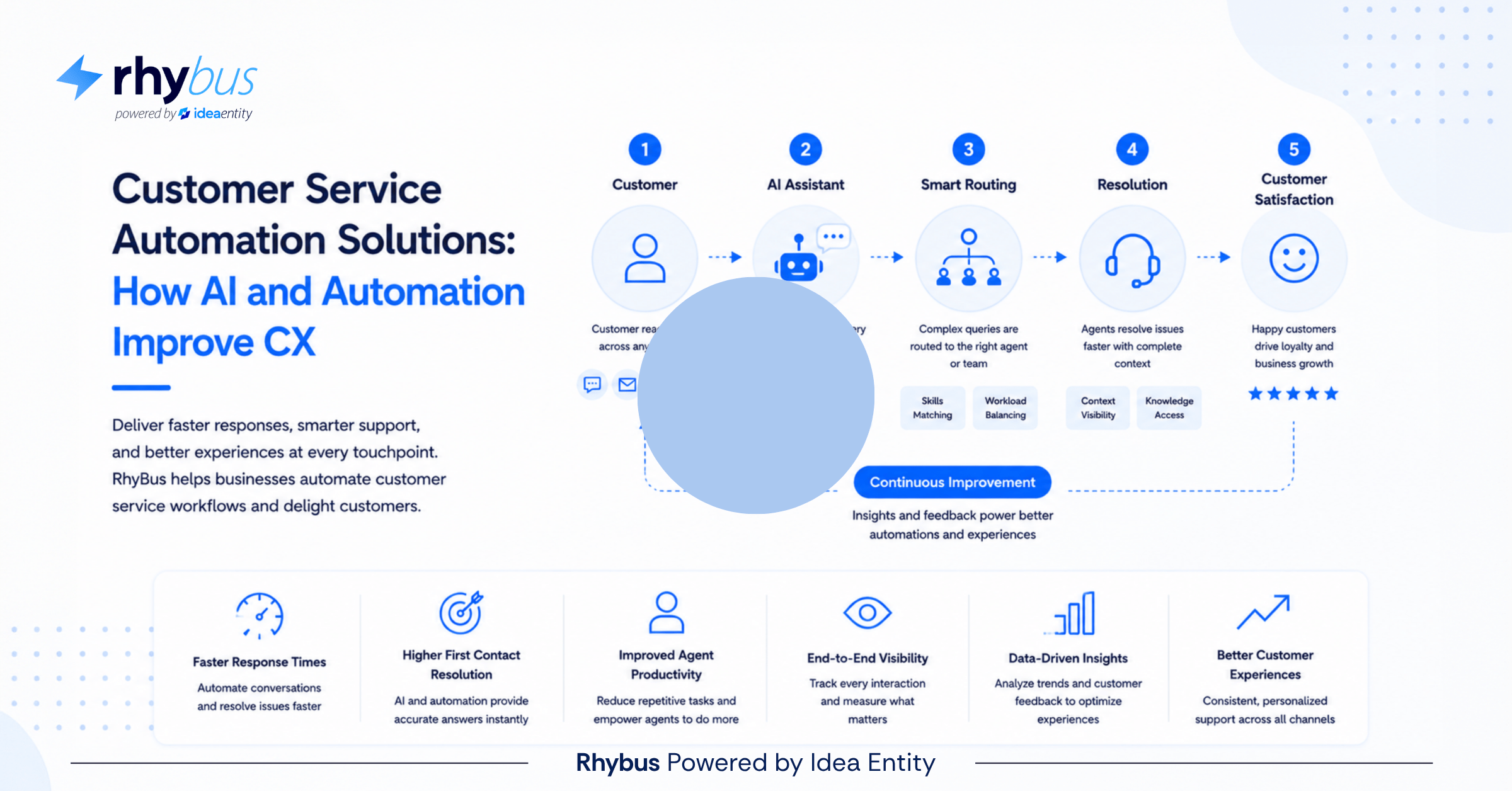
The most impactful AI customer service automation solutions go significantly beyond chatbot interactions. They apply intelligence to the operational workflows that determine whether customers receive fast, accurate, and consistent service at scale.
AI-assisted customer service automation operates at the workflow level: analyzing patterns across incoming requests, identifying which tickets are highest risk for SLA breach, routing requests to the agents most likely to resolve them efficiently, and surfacing operational trends that support proactive service improvements.
Specific applications of AI in customer service workflow automation include:
Intelligent ticket routing: Rather than distributing tickets to whoever is next in queue, AI-assisted routing analyzes ticket content, customer history, agent performance data, and current workload to match each request to the most appropriate available agent.
Predictive SLA management: AI identifies open tickets approaching SLA breach based on current response velocity and historical resolution patterns, enabling supervisors to intervene proactively, before a commitment is missed and before a customer is impacted.
Pattern-based issue identification: When multiple customers submit tickets describing the same underlying problem, AI-assisted analysis surfaces the pattern before it escalates into a broader service incident. This supports proactive communication rather than reactive damage control.
Sentiment and priority scoring: AI can analyze incoming communications to flag tickets from highly dissatisfied customers or issues likely to escalate, enabling supervisors to prioritize these cases before they become complaints.
Best Customer Service Automation Solutions: What to Evaluate
Identifying the best customer service automation solutions requires a different evaluation lens than general workflow automation. Customer service environments have specific operational requirements that general platforms are not always designed to handle.
Key capabilities to evaluate:
- SLA monitoring and automated escalation: The platform should track service commitments in real time and trigger escalation workflows when thresholds are approaching, not just after they have been missed. Retroactive alerts do not prevent SLA failures.
- Omnichannel workflow coordination: Customer issues move across channels. The best customer service automation solutions manage workflows that span email, phone, chat, and ticketing systems without creating coordination gaps between channels.
- Customer experience automation tools: Beyond ticket routing, look for platforms that automate the full customer interaction lifecycle, initial acknowledgment, progress updates, resolution confirmation, and follow-up communication, without requiring agents to manually manage each touchpoint.
- Cross-team workflow integration: Complex customer issues frequently require coordination across sales, billing, technical support, and product teams. The automation platform should support these cross-functional handoffs, not just ticket management within the support team.
- Resolution and satisfaction reporting: Operational dashboards should surface first-contact resolution rates, response time trends, SLA adherence, and customer satisfaction data, not just ticket volume counts.
Scaling Customer Service Automation Solutions
Scaling customer service automation solutions as support volume grows requires deliberate workflow design, not simply adding headcount or expanding the tool license.
Organizations frequently discover that workflows designed for lower volume environments break down at scale. Routing logic that worked at 100 tickets per day creates bottlenecks at 1,000. Manual escalation processes manageable with a small team become unsustainable as the support organization grows.
Effective scaling of customer service automation solutions requires:
Tiered support workflows: Define clear boundaries for issue complexity, with automated routing that matches ticket type to the appropriate resolution tier without requiring supervisors to manually triage. Routing logic should be based on issue content and customer context, not just queue position.
Structured escalation protocols: Every support team has informal escalation paths, but not every team has them documented, automated, and consistently followed. Formalizing escalation through workflow automation ensures high-priority and at-risk issues reach the right people reliably, regardless of who is on shift.
Dynamic capacity management: As ticket volume fluctuates across time zones and product events, automated routing should adjust to available agent capacity dynamically rather than maintaining static assignment rules that create uneven workload distribution and burnout.
Integration with upstream systems: Customer service workflows that connect to CRM, billing, and order management systems resolve faster because agents have the context they need without manually checking separate applications. Automation reduces both agents handle time and customer effort.
Customer Experience Automation Tools and Measurable CX Outcomes
The connection between customer experience automation tools and measurable CX outcomes is direct and well-documented. Organizations that automate customer service workflows consistently see improvement in the metrics that define service quality.
First response time: Automated acknowledgment and immediate intelligent routing eliminate the delay between ticket submission and first meaningful agent contact. Customers know their issue is being handled from the moment they submit, which itself reduces frustration and follow-up contact.
First contact resolution (FCR): When routing intelligence matches tickets to the agents best equipped to handle them, FCR rates improve measurably. Customers are transferred less often, need to recontact support less frequently, and have issues resolved in fewer interactions.
SLA adherence: Automated SLA monitoring and escalation workflows ensure commitments are tracked and enforced systematically. Organizations managing large ticket volumes consistently see significant SLA compliance improvement when monitoring moves from manual to automated.
Customer satisfaction (CSAT): Faster resolution, more consistent service, and fewer dropped tickets translate directly into higher customer satisfaction scores. The operational improvements automation delivers are customer-visible as better, more reliable service.
Agent satisfaction: When agents spend less time on administrative coordination and more time on meaningful problem-solving, job satisfaction and retention improve, which further improves service consistency and reduces the costly cycle of agent turnover.
How RhyBus Supports Customer Service Automation
Customer service operations at scale require a workflow platform built for high volume, tight timelines, and the cross-department coordination that complex customer issues demand.
RhyBus by Idea Entity supports customer service automation solutions across the workflows that drive customer experience outcomes:
-
-
- Ticket routing workflows that move requests to the right team or agent based on issue type, customer context, and availability, not just queue position
- Automated escalation management that triggers when SLA thresholds are approaching, giving supervisors time to act before commitments are missed
- Cross-department coordination workflows for issues requiring input from billing, sales, technical support, or operational teams
- Customer communication automation that delivers status updates at defined workflow stages without requiring agents to manually send each message
- SLA monitoring dashboards giving supervisors real-time visibility into ticket status, response times, and resolution performance across the team
-
RhyBus connects customer service workflows to the broader organizational environment. When a customer issue requires billing review, the coordination workflow triggers automatically. When a support ticket surfaces a product defect, the right stakeholders receive notification without a manual handoff. This cross-organizational connectivity reduces resolution time for complex issues and eliminates the communication gaps that damage customer experience.
Conclusion: Building a Smarter Customer Service Operation
Customer service is a direct reflection of how well an organization’s operations are working. When workflows are fragmented, tickets fall through the cracks, escalations happen late, and customers feel the impact.
Customer service automation solutions change that equation. By replacing manual coordination with structured, automated workflows, organizations can deliver faster responses, more consistent service, and meaningfully better customer experiences on a scale.
Key takeaways:
-
-
- Customer service automation is about workflow structure, not just speed, automation ensures every request follows a defined path with the right people notified at the right time
- AI-assisted intelligence improves proactive management, predictive SLA monitoring and smart routing help teams stay ahead of issues rather than reacting to them
- Scaling requires deliberate design, tiered workflows, structured escalation protocols, and dynamic capacity management must be built into the automation logic
- Customer experience automation tools provide the leadership visibility needed to manage support as a measurable operational function
-
Organizations that invest in customer service workflow automation are not just solving today’s ticket volume problem. They are building an operational foundation that scales with customer demand, supports distributed teams, and delivers the consistent service quality that drives long-term customer loyalty.
Ready to modernize customer service operations? Schedule a workflow assessment with RhyBus by Idea Entity to explore how customer service automation solutions can help your team deliver better experiences at scale.