Workflow automation platforms make a lot of promises. But the quality of what they deliver depends almost entirely on what is running underneath, the engine that determines how work actually moves through an organization.
Understanding what a workflow engine is, how it operates, and what distinguishes a capable one from a basic task coordinator is essential for any organization making a serious investment in process automation.
What Is a Workflow Engine?
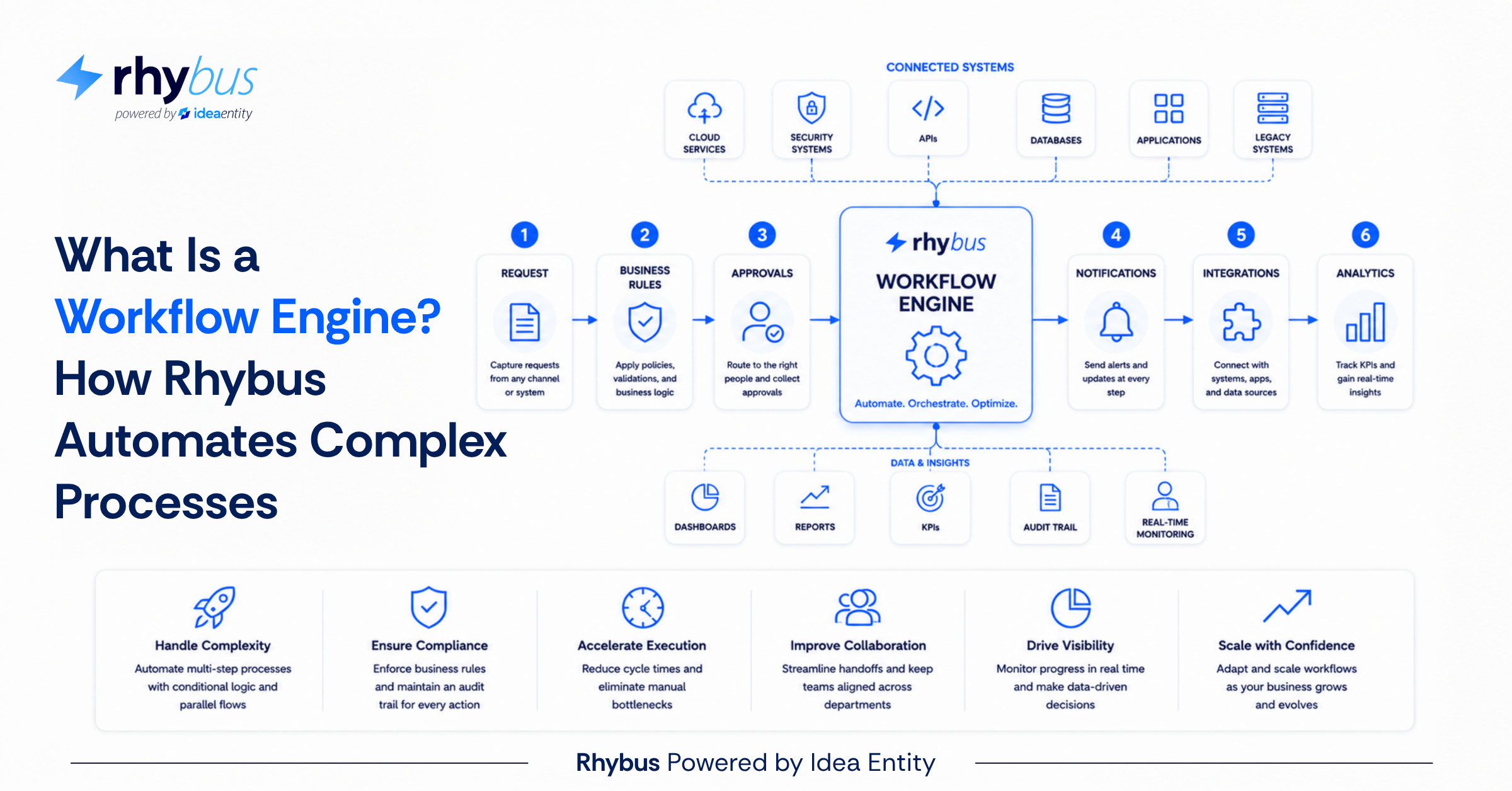
A workflow engine is the operational core that sits beneath automated business processes. It is the system that decides what happens next, and enforces that decision automatically.
When a procurement request is submitted, the workflow engine determines which approvers need to review it, in what sequence, and what happens if an approval is delayed beyond its deadline. When an employee is onboarded, the workflow engine coordinates task assignments across HR, IT, and facilities without requiring manual handoffs. When an incident is reported, the workflow engine routes it to the appropriate team and triggers escalation procedures when response thresholds are crossed.
The distinction between a workflow engine and a basic task management tool is fundamental. Task management tools track what needs to be done. A workflow engine defines and enforces how work moves through an organization, including the rules, conditions, dependencies, approvals, and exception handling that make real operational processes complex.
A workflow engine manages:
- Process logic: the rules that govern how workflows move between steps and what conditions trigger each transition
- Routing decisions: which people, teams, or systems receive tasks at each stage of a workflow
- Conditional branching: what happens when approvals are granted, rejected, delayed, or returned for revision
- Event triggers: actions that automatically initiate based on workflow conditions, time thresholds, or external signals
- State management: maintaining accurate records of where each workflow instance is at any given moment
- Audit and traceability: a complete, immutable record of every action taken within every workflow
As organizations grow and their processes become more interconnected, a workflow engine becomes the operational foundation that keeps everything moving reliably, without requiring human orchestration at each step.
How a Workflow Automation Engine Improves Operational Reliability
The most important improvement a workflow automation engine delivers is not speed, it is reliability. Manual process coordination fails in predictable ways, and those failures have predictable costs.
Approvals get missed because emails are buried. Tasks stall because no one realized they were waiting on someone else. Escalations happen too late because no one had visibility into how long a workflow had been idle. Compliance documentation is incomplete because manual processes depend on individuals remembering to record their actions.
A workflow automation engine eliminates these failure modes by making process logic explicit and system-enforced. Every transition between workflow stages is governed by defined rules. Notifications fire automatically at the right time. Escalations trigger based on predefined time thresholds, not on someone remembering to follow up. Documentation is generated by the system at each step, not assembled retroactively.
The result is not just faster processes. It is more consistent, more auditable, and more resilient ones. Organizations using a workflow automation engine can expect:
- Significantly fewer dropped handoffs between teams and departments
- Reduced time spent on manual follow-up, status checking, and coordination overhead
- Consistent process execution regardless of who is managing a specific workflow instance
- Faster identification of bottlenecks when workflows slow down
- Better operational data because workflow activity is captured systematically rather than intermittently
Why Organizations Need Enterprise Workflow Engines
Operational complexity tends to grow faster than the systems designed to manage it. Organizations that operated effectively with shared spreadsheets and email approvals at 50 employees often find those same approaches creating liability at 500.
Enterprise workflow engines are built for this reality. They handle the coordination demands that emerge when workflows span multiple departments, require multi-tiered approvals, depend on system integrations, and must meet governance or regulatory requirements.
What distinguishes an enterprise workflow engine from a general automation tool:
- It handles process complexity, not just task volume, enterprise workflows involve conditional logic, parallel approvals, exception paths, and dependencies that simpler tools cannot manage reliably
- It enforces governance at scale, audit trails, role-based access, and complete approval documentation become more critical, not less, as organizational complexity grows
- It integrates across systems, enterprise workflows rarely live in a single application; a capable workflow engine connects processes across HR systems, IT service platforms, finance tools, and operational applications
- It remains configurable without constant development, organizations must update workflows as processes change, without requiring engineering resources every time an approval chain is modified
The best workflow engine platforms are not rigid templates. They are designed to evolve alongside the organizations using them, maintaining governance and consistency while accommodating the operational changes that growth and market shifts require.
BPM Workflow Engine Capabilities
Business Process Management, BPM, brings a layer of strategic discipline to workflow automation. A BPM workflow engine does not just automate individual tasks. It manages end-to-end business processes as structured, measurable operational assets that can be analyzed, improved, and governed over time.
The practical difference shows up in how workflows are designed and monitored. A basic automation tool executes tasks. A BPM workflow engine treats the entire process as a managed operational capability with defined performance standards.
BPM workflow engine capabilities include:
- Process modeling: defining workflows visually before deploying them, making it easier to identify gaps, dependencies, and exception paths before they cause operational problems
- SLA management: setting performance targets for each workflow stage and tracking adherence over time, enabling process owners to identify where commitments are consistently at risk
- Process versioning: maintaining a record of workflow configuration changes and the ability to compare or roll back versions when process updates have unintended consequences
- Cross-functional process ownership: allowing different departments to own and manage their workflow segments within a unified operational framework
- Continuous improvement data: generating the workflow performance metrics needed to identify where processes should be redesigned, not just where they currently stand
For organizations with mature operational needs, BPM workflow engine capabilities are what separate workflow automation as a tactical fix from workflow automation as a strategic capability that compounds value over time.
Automation Workflow Engine Visibility and Governance
Operational visibility is where many workflow tools fall short. They can automate individual tasks, but they do not give leadership a coherent view of what is happening across the full portfolio of active workflows.
An automation workflow engine provides operational visibility by centralizing workflow data in a form that is actionable and current, not archived in logs that require manual review. Rather than generating records that someone must interpret later, it surfaces the information that matters most in real time.
Leadership teams using an automation workflow engine can see:
- Which workflows are currently active and at exactly what stage
- Where approvals are pending and precisely how long they have been waiting
- Which workflows have breached or are approaching their SLA thresholds
- How workflow volume and performance compare across departments and time periods
- Where recurring bottlenecks are concentrated and what process changes might address them
This visibility enables better operational decisions. It also enables governance by creating a comprehensive, documented record of workflow activity that supports audits, compliance assessments, and leadership reviews.
Governance features built into a workflow engine include: approval records capturing every decision with actor, timestamp, and outcome; process immutability ensuring workflows cannot be bypassed mid-execution without authorized intervention; escalation documentation recording when and why escalations were triggered; role-based access controls limiting who can view, action, or modify workflows; and compliance reporting outputs that support audit preparation and regulatory documentation.
AI-Assisted Intelligence Within the Workflow Engine
Modern workflow engines are incorporating intelligence capabilities that extend their value beyond execution and into operational optimization.
AI-assisted intelligence within a workflow engine context focuses on pattern recognition at scale, a capability that becomes increasingly valuable as workflow volume grows beyond what human monitoring can cover. A single delayed approval is a management issue. Fifty delayed approvals clustered around a specific approval stage in a particular workflow type is a process design problem that needs engineering attention, not individual follow-up.
Within a workflow engine, AI-assisted capabilities can:
- Analyze historical workflow data to identify which process stages are most prone to delays and under what conditions
- Flag active workflows following patterns historically associated with SLA breaches, before the breach occurs
- Surface anomalies in workflow volume or routing that may indicate a configuration issue or emerging operational problem
- Generate process redesign recommendations based on observed workflow performance data
- Support resource allocation decisions by highlighting where workflow demand is concentrated across teams and time periods
The goal is to help organizations shift from reactive workflow management to continuous process optimization. AI-assisted intelligence does not replace the governance structures or approval controls built into the workflow engine. It operates alongside them, giving operational and leadership teams the insight needed to make those structures work better over time.
How RhyBus Powers Workflow Automation
A workflow engine is only as valuable as the platform it runs on. RhyBus by Idea Entity is built around a flexible, enterprise-grade workflow engine designed to handle the operational complexity that growing organizations actually face, including the conditional logic, cross-department dependencies, and governance requirements that simpler tools cannot support reliably.
What makes RhyBus a strong fit for organizations investing in workflow engine capabilities:
- Configurable process logic: workflow rules, routing conditions, approval structures, and escalation paths are all configurable without custom development, giving operations teams direct control over how workflows are designed and modified
- Connected workflow orchestration: RhyBus connects workflows across departments so that changes in one process trigger the right downstream actions automatically, onboarding, IT provisioning, compliance tracking, and approval management work as a coordinated system
- Real-time operational visibility: dashboards give managers and leadership live insight into workflow status, pending approvals, SLA performance, and bottlenecks across all active workflows
- Governance by design: every workflow action is documented, every approval is recorded, and escalation rules are built into the process structure from the start, governance is structural, not enforced through manual oversight
- AI-assisted intelligence: operational patterns and workflow anomalies are surfaced automatically, helping teams identify and address process issues before they escalate
For organizations ready to build a scalable workflow foundation that supports governance, visibility, and operational reliability, RhyBus provides the engine, the infrastructure, and the platform expertise to get there.
The Future of Workflow Automation
Workflow engines are moving from back-office infrastructure to strategic operational capability. As organizations manage more interconnected processes, face greater compliance demands, and operate across more distributed teams, reliable, visible workflow orchestration becomes a genuine competitive differentiator.
The next phase of workflow engine development is less about adding features and more about deepening integration. Workflow engines will increasingly serve as the connective tissue between enterprise systems, bridging gaps between HR platforms, IT service tools, finance applications, and customer systems in ways that reduce manual coordination and improve end-to-end operational visibility.
Organizations investing in workflow engine capabilities now are building more than automation infrastructure. They are building the operational foundation that allows processes to scale, governance to be maintained, and workflow complexity to be managed systematically as the business evolves.
Ready to modernize workflow management and improve operational efficiency? Schedule a workflow assessment with RhyBus by Idea Entity to explore how a purpose-built workflow engine can support scalable, governed, and efficient enterprise operations.