Every organization eventually hits a coordination ceiling.
At smaller scales, processes run on relationships and institutional knowledge. Approvals happen through quick messages. Onboarding is managed by one coordinator who knows every department contact. Procurement moves through email because the leadership team personally reviews every major vendor relationship.
These approaches work, until they do not.
As headcount grows, departments multiply, and workflows span more stakeholders, the informal coordination that sustained smaller organizations becomes a liability. Work falls through gaps that no one designed and no one owns. An enterprise workflow management software platform exists to solve this problem, not by replacing human judgment, but by giving that judgment a structured operational framework to work within.
What Is Enterprise Workflow Management Software?
Enterprise workflow management software is a platform designed to standardize, automate, monitor, and govern workflows across departments and business functions at organizational scale.
The distinction between general task management tools and an enterprise workflow management system is significant. Task management tells people what to do. Enterprise workflow management software defines how work moves through the organization: which approvals are required, in what sequence, by which stakeholders, with what documentation, and under which governance requirements.
An enterprise workflow management system gives organizations:
- Structured approval routing across complex, multi-department processes
- Centralized visibility into workflow status, bottlenecks, and performance across the enterprise
- Governance infrastructure that ensures defined processes are followed consistently at scale
- Audit documentation generated automatically as workflows execute
- Scalable process frameworks that accommodate organizational growth without constant reconfiguration
The operational need for this infrastructure grows exponentially with organizational complexity. What begins as a coordination inconvenience becomes a governance risk as organizations add headcount, expand into new markets, and face increasing regulatory obligations.
Why Businesses Need Enterprise Workflow Management Systems
Growing organizations face a specific operational problem: their processes were designed for a smaller version of the company they have become.
Consider how common workflows transform at scale:
Employee onboarding at 50 people is a checklist. At 500 people, it is a multi-department workflow spanning HR, IT, facilities, legal, payroll, and the hiring manager, each with distinct dependencies, timelines, and accountability requirements. An enterprise workflow management system coordinates all of this automatically, ensuring every step is completed, documented, and visible.
Procurement at 50 people goes through the founder. At 500 people, it requires approval tiers based on spend thresholds, finance review, legal sign-off for contracts above certain values, and audit documentation for every vendor transaction. Business workflow management software enforces these requirements without manual orchestration.
Compliance at 50 people is managed by one person. At 500 people, compliance workflows span multiple departments, require documented evidence of process adherence, and must be auditable on demand. Enterprise workflow solutions make this tractable, systematically, not heroically.
Enterprise Workflow Solutions Support Scalable Growth
Scaling an organization is not just a headcount problem. It is a coordination problem. As teams expand and responsibilities spread across departments, the informal processes that worked at 20 people begin breaking down at 200.
Enterprise workflow management software addresses this by giving organizations a structured operational backbone that grows with them. Instead of relying on relationships and tribal knowledge to move work forward, teams operate within defined workflow structures that are consistent, traceable, and repeatable, regardless of team composition or organizational change.
Where general automation tools focus on eliminating individual manual tasks, enterprise workflow solutions are designed with organizational complexity in mind. They account for multi-tiered approvals, cross-department dependencies, geographically distributed teams, and the governance requirements that accompany scale.
An enterprise workflow solution specifically helps scaling organizations to:
- Align workflows across business units that previously operated with incompatible processes
- Enforce consistent approval structures even as team compositions and reporting lines change
- Maintain operational visibility across growing and increasingly distributed teams
- Support remote and hybrid workforce coordination without creating process gaps
- Reduce the operational drag that typically accumulates during periods of rapid growth
Organizations that invest in scalable workflow infrastructure early are far better positioned to onboard new teams, enter new markets, and manage increasing operational complexity without sacrificing consistency or governance.
Governance, Auditability, and Workflow Accountability
For enterprise organizations, governance is not a secondary concern, it is a business requirement built into how the organization operates.
Regulated industries, government contractors, and organizations managing sensitive data need more than efficient workflows. They need workflows they can prove. That means documented approvals, timestamped decisions, defined escalation paths, and the ability to produce complete audit records on demand.
Enterprise workflow management platforms support this through:
- Immutable audit trails that capture who acted, what they approved, and precisely when
- Role-based access controls that limit workflow visibility and action rights to appropriate stakeholders
- Automated escalation rules that surface stalled approvals before they create compliance exposure
- Structured approval routing that prevents workflows from bypassing required review steps
- Centralized compliance reporting that gives leadership a clear view of workflow health and adherence
The difference between governance as a feature and governance as a foundation comes down to platform architecture. Enterprise workflow management platforms treat auditability as a core design requirement, not something added later, ensuring organizations can scale operations without losing the oversight needed to manage risk.
How AI Supports Enterprise Workflow Intelligence
At enterprise scale, the coordination challenge is not a single delayed approval, it is hundreds of concurrent workflows, across dozens of departments, generating data volumes that no operations team can analyze manually.
Modern enterprise workflow management software incorporates intelligence capabilities that help organizations identify systemic patterns across their workflow data, rather than just tracking individual transactions. When approvals for a specific workflow type consistently stall at the same review stage across multiple departments, that pattern signals a process design problem, not an isolated management issue.
Enterprise-level workflow intelligence capabilities include:
- Cross-departmental pattern analysis that identifies structural inefficiencies across workflow types and teams
- Predictive bottleneck identification that surfaces which active workflows are likely to breach SLAs before they do
- Workflow benchmarking that compares performance across teams, locations, and time periods to identify best practices
- Trend analysis that supports strategic process improvement decisions at the organizational level
These capabilities help enterprise operations teams shift from reactive firefighting to proactive management. Governance decisions, approval structures, and escalation paths remain under human control, workflow intelligence provides better information, not automated decision-making.
How RhyBus Supports Enterprise Workflow Management
Managing workflows across a growing enterprise requires more than task assignment. It requires a platform that coordinates across departments, enforces governance at scale, and provides the operational visibility leadership teams need to make informed decisions.
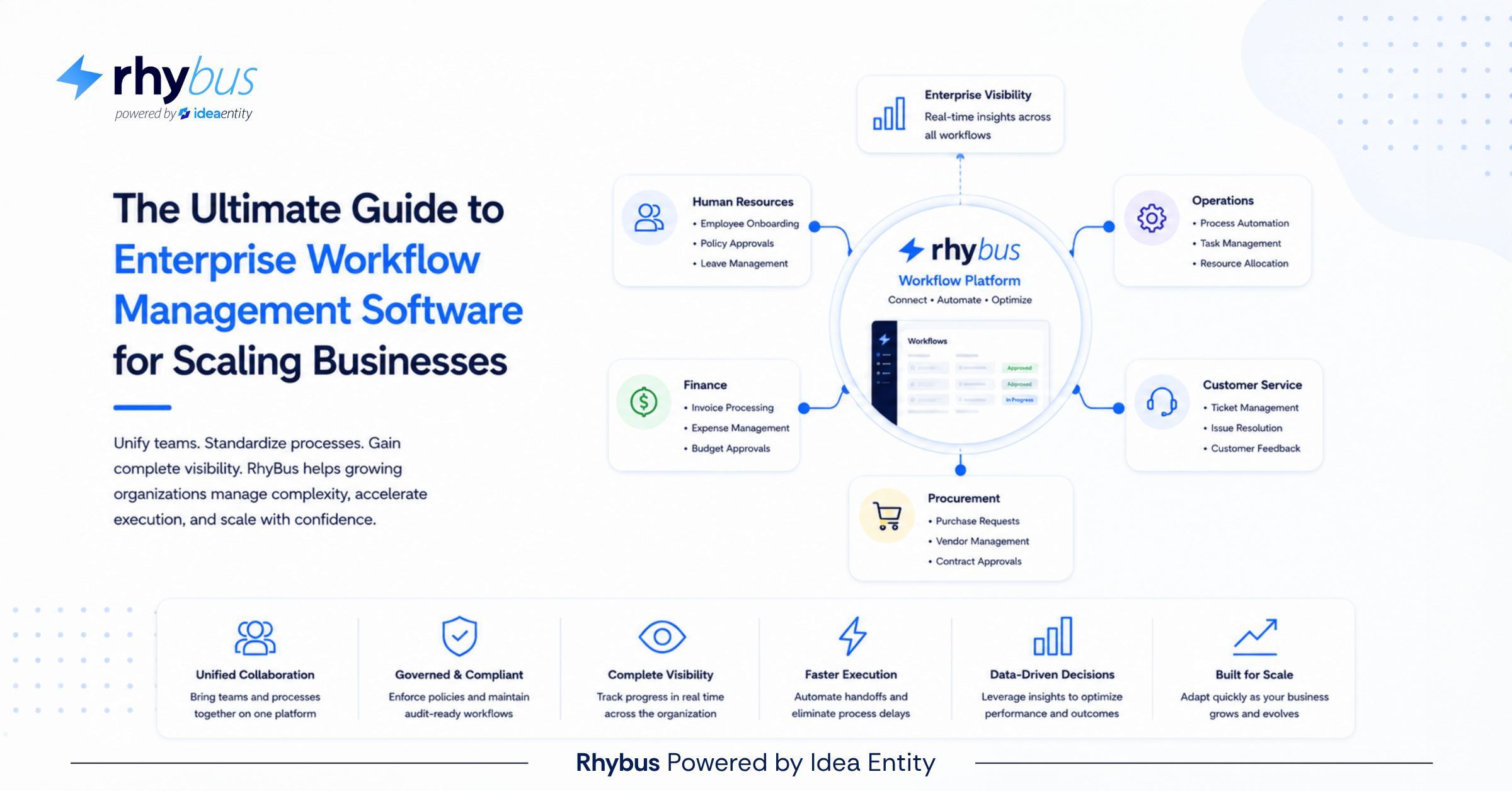
RhyBus by Idea Entity is built specifically for this level of organizational complexity. The platform supports enterprise workflow management across multiple business functions, with configurable orchestration that adapts as the organization evolves.
Where other platforms treat each workflow as a standalone process, RhyBus connects them. HR approvals inform IT onboarding tasks. Compliance reporting workflows connect to audit tracking. Customer service escalations link back to operational dashboards. The result is an environment where departments are operationally aligned rather than working in parallel silos.
Enterprise teams use RhyBus to manage:
- Multi-department onboarding and offboarding coordination across HR, IT, facilities, and management
- Procurement approval chains with finance and leadership review at appropriate spend thresholds
- IT service management workflows from request intake through resolution and documentation
- Compliance and audit workflows with built-in documentation generation and traceability
- Customer service coordination across support teams and operational stakeholders
- Executive dashboards and operational reporting that surface enterprise workflow health
For organizations that have outgrown generic workflow tools and need enterprise-grade process management, RhyBus provides the structure, governance, and scalability to support long-term operational maturity.
The Future of Enterprise Workflow Management
Organizational complexity is not slowing down. Companies continue growing, expanding into new markets, managing distributed workforces, and facing increasing regulatory scrutiny. The operational demands on enterprise workflow infrastructure will only intensify.
The organizations best positioned to manage this trajectory are those that treat enterprise workflow management as a strategic capability, not a back-office function to optimize later. The infrastructure organizations build today determines how effectively they can coordinate, govern, and scale tomorrow.
Several trends are shaping how enterprise workflow management platforms will evolve in the years ahead:
- Deeper integration between enterprise workflow platforms and the broader organizational technology stack
- Expanded AI-assisted intelligence for surfacing operational patterns across high-volume workflow environments
- Growing demand for platforms that simultaneously support compliance requirements and operational agility
- Increasing emphasis on cross-functional workflow visibility as organizations move away from departmental silos
Organizations that build scalable workflow infrastructure now, before coordination complexity becomes a crisis, will be far better equipped to maintain governance, improve efficiency, and adapt to changing business demands over time.
Ready to modernize operational workflows and improve enterprise process management? Schedule a workflow assessment with RhyBus by Idea Entity to explore how enterprise workflow management software can help your organization scale with confidence.